
Remember Not To Forget

Imagine it’s 2 a.m. and you are stuck in your room revising for an exam. You’ve hit a wall, completely overwhelmed by all theflashcards and notes you’ve spent weeks preparing. Nothing seems to stick, and an obvious question starts to creep into your mind:

How does memory actually work?


In school, students are traditionally rewarded for their ability to reproduce content on an exam paper; the greater the accuracy, the higher the mark. But our minds, don’t simply record information like a photocopier. Instead, memory works through several distinct stages, each plays a different role in how we abosrb, process, and retain information


Short-Term Memory (The Phone Number Paradox)


First up is short-term memory (STM). As the name suggests, STM allows us to hold only a small amount of information for a brief period.


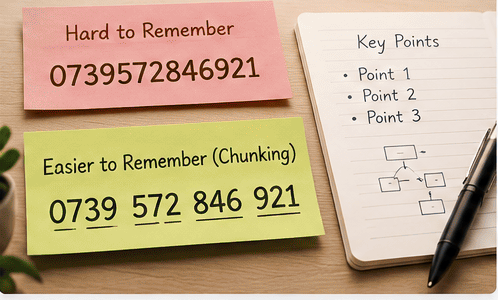
Imagine when some shares their phone number with you. You can repeat it in your head just long enough to dial them, but it is completely gone five minutes later.


STM is something of a trick pony. Its job is simply to hold a small amount of information briefly, and forgetting is the default setting. In many ways,  It works just like the reminder app on your phone. Its purpose is to help you keep track of things you might otherwise forget. So, its job is to prevent you from forgetting, rather than remembering – ironic isn’t it?


Working Memory: The Brain’s RAM

Have you ever wondered how your laptop never slows down with 40 tabs open in the background? You can thank your computer’s RAM. It temporarily holds the data of those active tabs so you can switch between them smoothly.


Your brain has its own version of RAM, and it’s called Working Memory (WM).


When you are writing an essay, your working memory keeps multiple mental “tabs” running at the same time. It balances the sentence you are currently typing, the main argument of your paragraph, and that new article you just read. Think of it as a busy workshop where ideas are constantly sorted, shaped, and juggled. It is what allows you to multitask and build a coherent argument without completely losing your mind.


The catch? Just like a web browser with too many windows open, your working memory has a strict limit. There is only so much data your brain can actively process before the system crashes.


A Simple Study Heck: Chunking

Fortunately, you can easily upgrade your memory efficiency. Good sleep and regular exercise  make all the difference.But if you want an immediate study hack, look no further than chunking.


Even if you have never heard the term, you use it every single day.


Have you ever wondered why phone numbers are split up with dashes instead of being one long string of digits? Or why lecture slides and revision notes are broken down into bullet points? It is because our brains naturally struggle with massive walls of data. If you divide information into small, manageable chunks, your working memory can handle it with ease.


Long Term Memory – Your Personal Library 


Think of long-term memory (LTM) as a massive, permanent library. It is where you stash away all the truly good stuff. Each book shelf is packed with different genres. If one day you fancy riding the bike along the beach, you head straight to the “muscle memory” aisle. If you are craving your favourite chocolate cake, you pop over to the “recipe” aisle.


LTM holds information that lasts for days, months, or even a lifetime. These memories shape who we are, guide our daily choices, and help us navigate the world. They are unique fragments of our identity, patiently sitting on the shelves until we decide to retrieve them.


Memorisation Isn’t Learning


Learning is impossible if you cannot actually retain the data. However, true learning only comes to fruition when you move past robotic memorisation and can explain a concept in your own terms. As the famous saying goes “If you can’t explain it simply, you don’t understand it well enough.”


To get the most out of studying, we have to look past the exam paper and focus on how the mind absorbs, retains, and manipulates information. That is how you turn temporary facts into real, lifelong knowledge.


Oxford Has Just Replaced All Its Admissions Tests. Here Is What Every Applicant Needs to Know.


In January 2026, the University of Oxford confirmed the most significant overhaul of its undergraduate admissions testing in decades. The suite of in-house examinations that preceded the famous admissions interviews have been replaced with three tew assessments; the TMUA, ESAT and TARA. Registration for the new tests opens this summer. There is very little time between now and then.

What has been scrapped

Oxford confirmed in January 2026 that from the 2027 admissions cycle, it is retiring the majority of its admissions tests, aside from the UCAT for Medicine and LNAT for Law. The eight tests being discontinued are the Mathematics Admissions Test (MAT); the Physics Aptitude Test (PAT); the Thinking Skills Assessment (TSA); the Modern Languages Admissions Test (MLAT); the Classics Admissions Test (CAT); the Philosophy Admissions Test (PhilAT); the Biomedical Sciences Admissions Test (BMSAT); and the Ancient History and Classical Archaeology Admissions Test (AHCAAT). [1]

What replaces them

Oxford has joined the UAT-UK alliance, a collaboration between Imperial College London and the University of Cambridge whose computer-based tests are delivered online through Pearson VUE test centres worldwide. [1] Three tests now cover Oxford’s full range of affected courses.

The TMUA (Test of Mathematics for University Admission) replaces the MAT for Mathematics, Computer Science and related courses. The TMUA doesn’t include the extended-answer questions of the MAT; the emphasis is on solving a larger number of questions fairly quickly within the time limit. [2]

The ESAT (Engineering and Science Admissions Test) is utilised for Engineering, Physics, Biomedical Sciences and related courses. The ESAT is a modular assessment where students have to pick different modules based on the courses they are applying for. Each section comprises of 27 questions and has a duration of 40 minutes. Students are advised to book their sitting well in advance. [3]

The TARA (Test of Academic Reasoning for Admissions) replaces the TSA for Economics and Management, Human Sciences and related social science and humanities courses. The TARA is a subject-neutral reasoning test focused on how candidates think and respond to unfamiliar material. [4]

Oxford’s own admissions page confirms that applicants for all affected courses must sit the October test sitting. The January sitting is not available to Oxford or Cambridge applicants. [1]

Why this changes things more than it might appear

The move to shared UAT-UK tests has a consequence beyond format change: Oxford, Cambridge and Imperial now all use the same assessments, meaning a single score is directly comparable across all three institutions simultaneously.

The more immediate consequence concerns preparation resources. The MAT had almost thirty years of published past papers behind it. As exams.ninja noted in their January 2026 analysis, the question banks, preparation guides and revision routes that generations of Oxford applicants have relied upon are no longer applicable to the tests that will be sat in October 2026. [5]

Where things stand right now

Registration details for 2027-entry tests are being published via the UAT-UK website at esat-tmua.ac.uk, which already contain preparation materials for the ESAT and TMUA. The TARA preparation resources are available through the same platform. These are the authoritative starting points and the only reliable preparation materials currently available.

For Law applicants, LNAT registration for Oxford and Cambridge opens on 1 August 2026 and closes on 15 September 2026. The test must be sat by 15 October 2026. [6] For Medicine applicants, UCAT registration typically opens in early summer and testing runs from July through to September.

Everything written above applies specifically to Year 12 students applying in autumn 2026.

At Athena Tuition, our Oxbridge admissions tutors work with students from Year 12 on preparation for both the new UAT-UK tests and the broader Oxford and Cambridge applications. If your child is planning to apply to Oxford in 2026 and has not yet begun structured preparation for the new test framework, now is the right time to start.

Call us on 0208 133 6284 or email enquiries@athenatuition.co.uk


Sources and references

  1. Oxford University official admissions tests page, confirming discontinued tests, new UAT-UK framework, October sitting requirement, UCAT and LNAT exceptions: ox.ac.uk/admissions/undergraduate/applying-to-oxford/guide/admissions-tests
  2. TMUA replacing MAT: emphasis on mathematical reasoning and precision rather than syllabus depth and extended problem-solving: u2tuition.com/resources/oxford-tmua-and-esat-shift
  3. Times Higher Education, September 2025: ESAT and TMUA introduced in 2024, TARA first used in 2025, all tests taken online at Pearson VUE centres with limited capacity, students advised to book well in advance: timeshighereducation.com/counsellor/admissions-processes-and-funding/admissions-tests-uk-universities-all-you-need-know
  4. TARA replacing TSA for social sciences and humanities, subject-neutral reasoning test focused on unfamiliar material: ox.ac.uk/admissions/undergraduate/applying-to-oxford/guide/admissions-tests and dukesplus.com/guides/applying-to-university-in-the-uk/uk-university-admissions-tests/tara-test-guide
  5. UAT-UK past papers from discontinued tests not recommended for TMUA and ESAT preparation due to different formats; TSA partial exception for TARA: exams.ninja/guides/oxford-admissions-tests-changes (January 2026)
  6. LNAT registration for Oxford and Cambridge applicants: opens 1 August, closes 15 September, test to be sat by 15 October: theuniguide.co.uk/advice/ucas-application/which-admissions-tests-do-i-need-to-take